


When we think of great mothers, our minds often turn to human acts of sacrifice and tireless care. Yet, the true definition of devotion is written across the landscapes and oceans of the animal kingdom.
From the freezing depths where a mother octopus starves for years to protect her eggs, to the vast savannas where elephant matriarchs pass down life-saving wisdom, nature’s caregivers redefine what it means to give everything for the next generation.
These stories of profound sacrifice, fierce protection, and learned skill reveal that the most fundamental and complex form of love is not always instinctual—it is earned, taught, and deeply rooted in experience.
The animal kingdom presents remarkable mothers whose devotion extends far beyond human expectations. Deep-sea octopus mothers guard their eggs for four-and-a-half years, remaining motionless as they slowly starve. Elephants maintain pregnancies lasting nearly two years. Ball pythons, despite reaching lengths of 15 feet, dedicate months to protective maternal care without feeding.
The most maternal animals prove that motherhood manifests through countless variations across species. These mothers sacrifice their bodies, teach survival skills, and demonstrate protective behaviors that defy conventional understanding. Animal mothers who dedicate everything to their offspring, alongside species that represent motherhood through unexpected forms of devotion, offer important lessons about parental care. Maternal behavior develops through experience rather than pure instinct, a pattern that appears natural across both animal and human populations.
Key Takeaways
Animal mothers demonstrate that parenting develops through experience and adaptation rather than automatic instinct, providing essential insights for understanding caregiving across species.
- Sacrifice manifests differently across maternal species – commitment ranges from extended brooding periods to significant body weight loss during offspring care, with each species adapting to environmental demands.
- Caregiving skills develop through practice and exposure – both male and female animals acquire identical parenting capabilities when given time with young, regardless of biological sex.
- Support networks enhance offspring survival – cooperative breeding patterns across multiple species show that additional caregivers substantially improve success rates, particularly during challenging conditions.
- Parental adaptation requires time and patience – the caregiving brain forms through gradual adjustment, making initial uncertainty and fatigue normal components of the developmental process.
- Protective behavior transcends traditional roles – from male pregnancy to extended tadpole transport, dedicated care appears in unexpected forms that challenge conventional assumptions about gender and parenting.
Animal mothers show us that successful caregiving requires learning, support, and time to develop. Whether observing protective behaviors in wildlife or adapting to infant care needs, parenting represents a skill that improves through experience and community assistance.
Best animal mothers that sacrifice everything for their young
Among the most maternal animals, certain species demonstrate sacrifice that extends beyond physical survival.
The deep-sea octopus that starves for years
Researchers from the Monterey Bay Aquarium Research Institute discovered a single octopus mother at 1,400 meters depth in Monterey Canyon in 2007. She remained fixed to the same rock face through 18 research visits spanning four and a half years.
Graneledone boreopacifica brooded approximately 160 eggs for 53 months without consuming food. Scientists offered crab pieces through robotic arms. She refused every offering. Her initially purple, textured skin faded to pale transparency. Her body shrank progressively, eyes clouding as months passed. Water temperatures near 3°C slowed her metabolism, yet her vigil continued without interruption. Researchers found only empty egg capsules on their final visit. The young had hatched successfully, and the mother was gone.
The python that stops eating for six months
Female ball pythons coil around their egg clutches for two months, refusing food throughout nest attendance. Eggs constitute 54% of post-laying body mass.
Brooding females lost merely 6% of initial body weight during this period. South Togo’s 30°C ambient temperatures eliminated the need for maternal heat generation. Maternal presence prevented egg dehydration and protected against yolk desiccation. Brooding behavior significantly improved hatching success while requiring minimal energy expenditure.
The elephant seal mother’s dangerous journey
Northern elephant seal mothers demonstrate sacrifice through precise body allocation. During four weeks of nursing, mothers lose 2 pounds for every pound gained by pups, ultimately losing 40% of original body weight. Milk fat content reaches 60% by weaning, supporting pup growth from 80 to 300 pounds.
Mothers then permanently abandon offspring. Among these dedicated mothers, only 1% achieve “super mom” status, living 23 years and nursing up to 20 pups. The remaining 75% die before reaching breeding maturity.
Most maternal animals that teach and protect
Certain species excel through extended educational investment rather than immediate physical sacrifice.
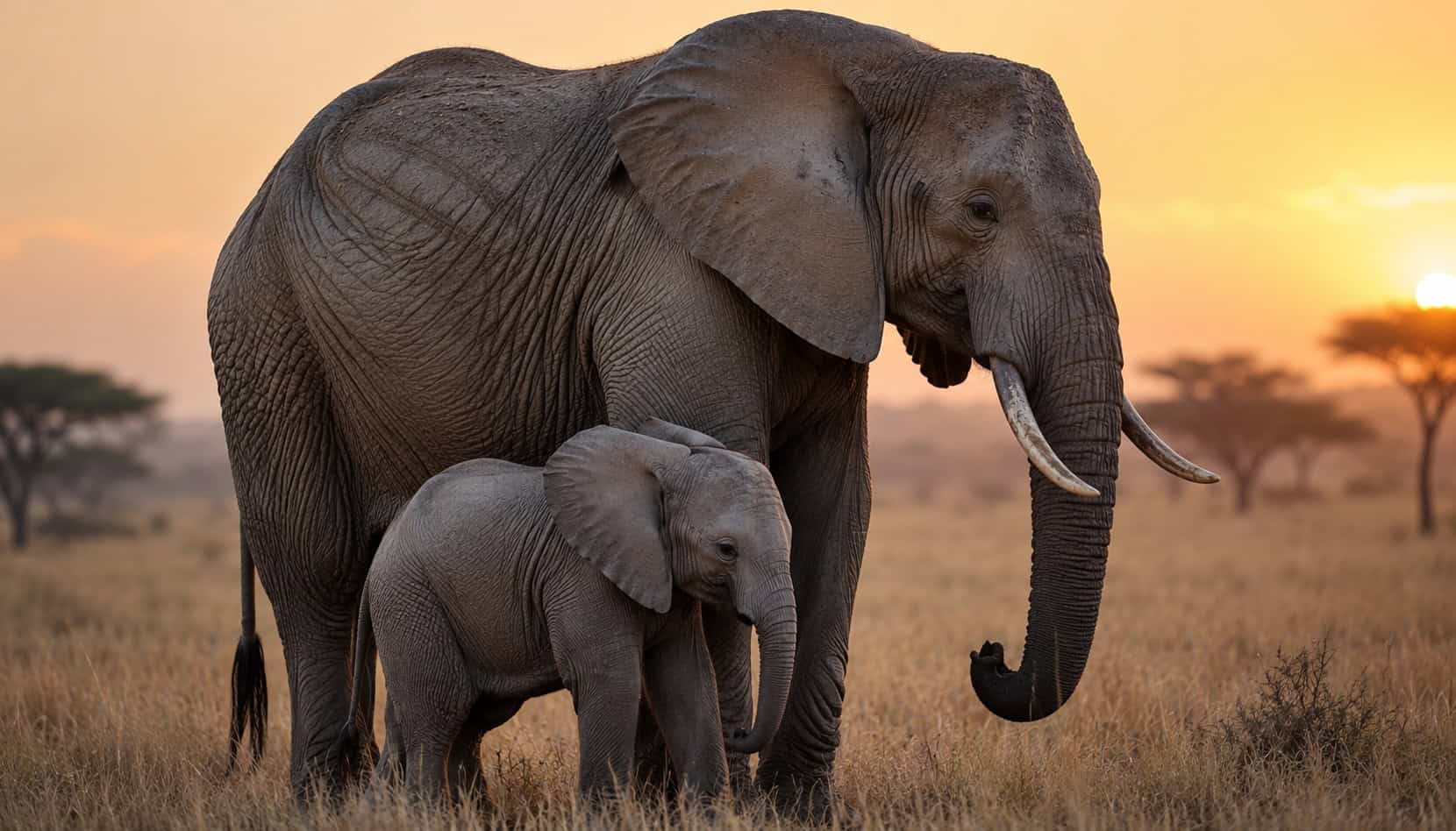
Elephant matriarchs and their lifelong bonds
Elephants carry their young for 22 months, the longest gestation period among mammals. Female calves remain with their mothers throughout their lives. Family units of 3 to 25 individuals follow a matriarch, typically the eldest female, who determines movement patterns, feeding locations, and responses to threats.
The matriarch’s accumulated knowledge directly impacts family survival rates. Tanzania’s Tarangire National Park experienced a severe nine-month drought in 1993. Infant mortality rates increased from 2% to 20%. Family groups led by experienced matriarchs who guided their herds outside the park boundaries maintained significantly lower infant mortality rates. The eldest female’s memory of alternative water sources and feeding areas determined which calves survived the drought.
Orangutan mothers and eight years of training
Female orangutans provide care for more than eight years, creating the longest dependency period after humans. Young orangutans must master identification and processing techniques for over 200 different food sources. Mothers use graduated teaching methods, providing initial food sharing before systematically reducing assistance as offspring develop skills.
Food-sharing patterns demonstrate sophisticated educational timing. Maternal assistance rates peaked after infants began eating solid food, then decreased systematically after age five. Mothers maintained longest support periods for complex food items like neesia fruit, requiring specialized processing techniques.
Lion prides and collaborative mothering
Female lions coordinate birth timing and implement collective cub-rearing systems. Communal care encompasses shared nursing duties and protection protocols, particularly defense against infanticide. Cubs develop hunting capabilities through sibling interaction and adult observation.
Orca mothers who never stop caring
Orca pregnancies last 18 months, followed by nursing periods extending one to two years. Male offspring maintain maternal bonds throughout their lives. Each surviving son reduces a mother’s reproductive capacity by more than 50%. Mothers continue food provisioning to adult sons through direct salmon sharing, as males demonstrate limited independent hunting success[132].
Animals that represent motherhood through unexpected devotion
Animal mothers that represent devotion often challenge traditional expectations about parental care. The most remarkable examples prove that maternal behavior extends far beyond conventional gender roles.
Male seahorses redefining parental roles
Male seahorses carry young in specialized brood pouches, experiencing true pregnancy lasting 10 to 25 days depending on species. These fathers incubate up to 2,000 babies at once. Male hormones, not female ones, activate the pregnancy process. The pouch functions like a womb, providing oxygen and nutrients through a placenta derived entirely from the father’s skin.
Poison dart frogs carrying tadpoles for miles
Poison dart frog fathers transport tadpoles on their backs to separate water pools after eggs hatch. Three-striped poison frogs travel up to 400 meters, passing closer pools an average of 52 meters away. Dyeing dart frogs journey approximately 39 meters on average. Tadpole transport occurs after 15-20 days of larval development, mainly after heavy rains. Fathers separate tadpoles because they’re cannibalistic.
Crocodile mothers with gentle jaws
Mother crocodiles guard eggs for three months before carefully gathering hatchlings in a throat pouch beneath deadly teeth. Despite possessing the strongest bite in nature, instinct prevents mothers from closing their mouths. They transport up to 15 babies at once. Crocodile mouths contain special pressure sensors that control exactly how much force they use.
Prairie vole mothers building communities
Prairie voles display diverse family structures, including single mothers, biparental pairs, and cooperative groups where older offspring help rear pups. Females raised by single mothers showed lower interest in infants and took longer to form pair-bonds than those raised by both parents. Males raised without fathers also experienced delayed pair-bond formation.
Animal mothers and human parenting connections
Animal mothers provide important insights about parenting behaviors across species.
Parental behavior development through experience
Research on parenting behaviors demonstrates that anyone who commits to caring for a baby can develop parental responses, regardless of sex or path to parenthood. Both male and female rats, when exposed to pups, developed identical maternal behaviors. Time spent with young influenced development more than hormonal changes. The concept that women possess innate maternal instinct represents repeated misinformation rather than scientific fact.
Natural adaptation periods for new parents
New parents experience hyperresponsiveness during the first months postpartum, engaging in intensive learning to read and respond to infant cues. Most mothers feel overwhelmed, unprepared, and exhausted during this transition period. The parental brain develops through adaptation rather than automatic activation, creating inherently demanding circumstances.
Community support across mammalian species
Cooperative breeding appears across mammal species where helpers assist breeding females in raising offspring. Research confirms that helpers improve offspring survival rates, particularly under harsh environmental conditions. Community support provides essential care and resources that parents require for successful child-rearing.
Parenting patterns across animal and human populations
Octopus mothers starving for years alongside male seahorses experiencing pregnancy demonstrate that caregiving varies significantly across species. Animal mothers show that parenting remains a learned behavior with substantial influences from experience. These patterns appear consistently in both animal and human parenting development.
Conclusion
The best mothers in the animal kingdom show us that devotion takes countless forms, and maternal behavior develops through experience rather than instinct. Similarly, human parents shouldn’t expect caregiving to feel natural immediately. Struggle is part of the process, not a sign of failure. After all, whether you’re an octopus starving for years or a human learning to read your baby’s cues, motherhood remains a learned journey that deserves support and patience.
FAQs
Q1. Which animals are considered the best mothers in nature? The animal kingdom features remarkable mothers including deep-sea octopuses that guard their eggs for over four years without eating, elephants that carry their young for 22 months and maintain lifelong bonds, orangutans that nurture offspring for eight years while teaching survival skills, and orcas whose mothers share food with their adult sons throughout their lives. Each demonstrates extraordinary devotion through different forms of sacrifice and care.
Q2. How long do orangutan mothers care for their young? Orangutan mothers nurse and care for their young for more than eight years, making them second only to humans in dependency length. During this extended period, mothers teach their offspring to recognize and process over 200 different food items, using a gradual approach that slowly reduces support as the young mature and develop independence.
Q3. Do male animals ever take on mothering roles? Yes, several species challenge traditional parental roles. Male seahorses experience true pregnancy, carrying up to 2,000 babies in specialized brood pouches for 10 to 25 days. Poison dart frog fathers transport tadpoles on their backs for hundreds of meters to separate water pools. These examples show that devoted parental care isn’t limited to females and can take unexpected forms across different species.
Q4. Is maternal instinct really natural or is it learned behavior? Research shows that maternal behavior is primarily learned rather than purely instinctive. Studies on both animals and humans demonstrate that anyone who commits to caring for a baby can develop parental responses through experience and time spent with the young, regardless of sex or biological connection. The parental brain develops through adaptation, which explains why new parents often feel overwhelmed initially.
Q5. Why is community support important for mothers across species? Cooperative breeding exists across many mammal species where helpers assist in raising offspring, significantly improving survival rates, especially under harsh conditions. This pattern reflects the natural need for support systems in parenting. Just as animal mothers benefit from group care and shared responsibilities, human parents also require community support and resources to successfully navigate the challenging transition to parenthood.